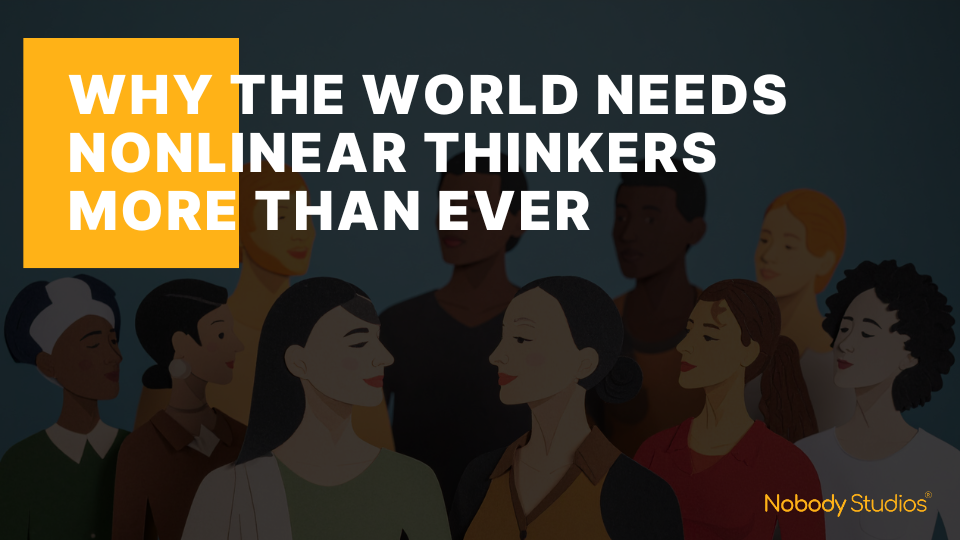

The problems facing society today are complex, interconnected, and rapidly evolving. From broken education systems to rigid corporate structures, many of the challenges we struggle to solve persist not because of a lack of intelligence—but because of how narrowly we’ve trained ourselves to think.
At the heart of this issue lies a tension between linear thinking, which values predictability, specialization, and control, and nonlinear thinking, which embraces complexity, creativity, and unconventional connections. Understanding the difference—and learning how to balance the two—may be one of the most important leadership skills of our time.
Linear vs. Nonlinear Thinking: What’s the Difference?
Linear thinking follows a straight path:
Do this → get that result.
It’s structured, efficient, and easy to manage. Schools, corporations, and institutions are largely built around this model—schedules, KPIs, hierarchies, and standardized expectations.
Nonlinear thinking, on the other hand, is associative and adaptive. It connects ideas across disciplines, tolerates ambiguity, and often thrives in uncertainty. Nonlinear thinkers tend to:
- See patterns others miss
- Connect seemingly unrelated ideas
- Take creative risks
- Challenge assumptions and “unwritten rules”
Ironically, while most breakthroughs in history come from nonlinear thinking, our systems are optimized to reward linear behavior.
How Education Trains Creativity Out of Us
Children are naturally nonlinear. They explore, ask unexpected questions, and learn through experimentation. But formal education often shifts this mindset early—rewarding conformity, individual performance, and rigid correctness.
Timetables, standardized testing, and silent classrooms teach students how to think rather than how to explore. For children who are neurodivergent—those with dyslexia, ADHD, autism, or other cognitive differences—this system can be especially damaging. Instead of being supported, many are made to feel like they’re “not doing a good job,” even when their strengths lie outside traditional metrics.
The result? Talented minds learn to suppress what makes them unique.
Neurodiversity Is Not a Deficit—It’s an Advantage
Nonlinear thinking is deeply connected to neurodiversity. People whose brains work differently often bring:
- Greater creativity
- Higher risk tolerance
- Unconventional problem-solving skills
- The ability to connect dots others don’t even see
Yet these same people frequently struggle to thrive in rigid environments filled with unspoken expectations. Many organizations claim to value diversity, but few design systems that truly accommodate different cognitive styles.
True inclusion isn’t about forcing people to fit the system—it’s about reshaping the system to fit people.
Why Startups Innovate—and Corporations Stall
Every company begins with a nonlinear thinker: a founder who sees something others don’t. Early-stage startups tend to be chaotic, creative, and flexible—qualities that fuel innovation.
As companies scale, systems are introduced to manage growth. This is necessary. But over time, systems can become the goal rather than the support structure. When efficiency overtakes curiosity, innovation slows.
The challenge for leaders is not choosing between structure and creativity, but maintaining balance:
- Linear systems to execute and scale
- Nonlinear space to explore, experiment, and adapt
When one dominates the other, organizations lose resilience.
Building Cultures Where Different Minds Can Thrive
Healthy, future-ready organizations share a few key cultural traits:
1. Psychological Safety
People must feel safe to speak up, challenge ideas, and be themselves—without fear of punishment or exclusion.
2. Flexibility Over Control
Rigid rules and “this is how we’ve always done it” thinking stifle innovation. Flexible environments allow new ideas to surface organically.
3. Human-Centered Leadership
Leaders who value people over process understand that performance and compassion are not opposites. Accountability and empathy can coexist.
4. Trust in Emergence
Not everything needs a blueprint. Some of the most impactful ideas emerge through experimentation, dialogue, and shared exploration.
From Communities to Mycelium
Instead of rigid “communities” with fixed rules and hierarchies, a more powerful model is mycelium—a decentralized, organic network where individuals support and nourish one another.
In nature, mycelium connects trees, plants, and fungi, allowing them to share resources and information. Applied to human systems, this model encourages:
- Peer-to-peer collaboration
- Shared ownership of ideas
- Collective problem-solving
- Growth without central control
This kind of network thrives on trust, openness, and contribution rather than authority.
Innovation Starts With Being “Okay”
A sobering truth underlies many systemic failures: too many people are not okay.
Trauma, burnout, exclusion, and chronic pressure have become normalized. Institutions often reinforce this by prioritizing output over well-being, compliance over curiosity.
When people are not okay, creativity shuts down. Innovation stalls. Conflict rises.
Organizations that want to build meaningful, sustainable impact must start by helping people feel seen, valued, and supported—especially those who don’t fit neatly into existing boxes.
The Future Belongs to Those Who Think Differently—Together
The biggest challenges of our time won’t be solved by doing more of the same. They require new perspectives, diverse minds, and the courage to rethink how we work, learn, and lead.
Nonlinear thinkers have always been here. The opportunity now is to stop sidelining them—and start building systems where they can thrive.
Because the future isn’t linear.
And neither are the people who will shape it.