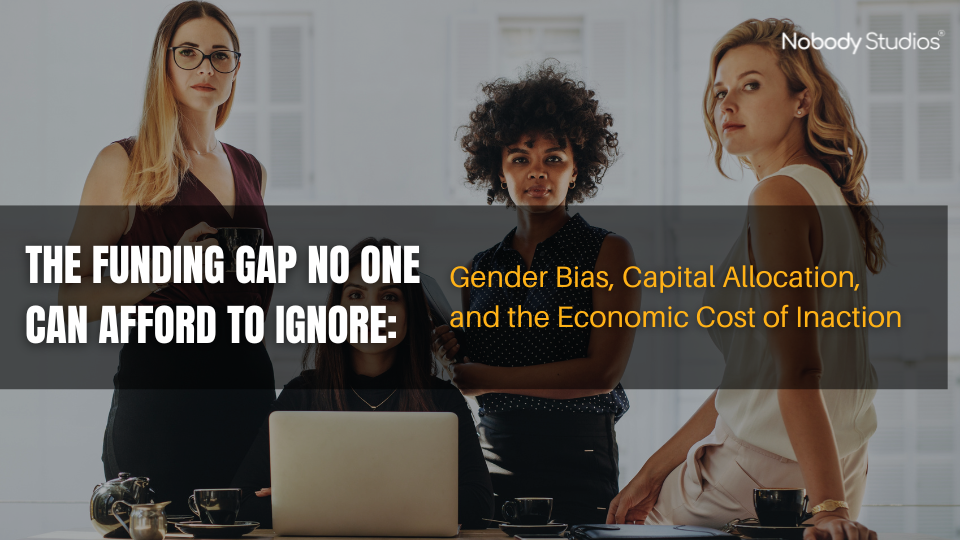

Venture capital prides itself on backing the future.
But when it comes to funding female and underrepresented founders, the data tells a different story.
Despite decades of conversation around equality, female-founded startups have never received more than 3% of venture capital funding in the United States. In the UK and Europe, the number hovers closer to 1–2%. In some cases, the figures are even more stark—over a ten-year period in the UK, only a handful of Black female founders secured venture funding.
This is not a pipeline issue.
It is not a performance issue.
And it is certainly not a talent issue.
It is a systemic capital allocation problem—with enormous economic consequences.
The Three Structural Drivers of the Funding Gap
Research and investor behavior reveal three primary forces at work.
1. Inherent Bias—Often Unconscious, But Deeply Embedded
Bias rarely announces itself.
Studies show that from early childhood, gender-based social conditioning shapes expectations about leadership, risk-taking, and ambition. These patterns follow founders into investor meetings.
One of the most striking findings comes from research analyzing startup pitch competitions over a decade. There was no measurable difference in how men and women pitched. However, investors asked dramatically different questions:
- Men were asked promotion-focused questions:
How will you scale? How will you capture market share? - Women were asked prevention-focused questions:
How will you defend against competition? How will you mitigate risk?
Even more revealing: this bias appeared among both male and female investors.
Founders who reframed prevention questions into promotion-style answers were significantly more likely to receive funding. The takeaway? Capital is influenced as much by framing and perception as by fundamentals.
2. Underrepresentation in Decision-Making Rooms
Venture capital remains overwhelmingly homogenous.
Investment committees often reflect similar educational backgrounds, networks, and lived experiences. Research shows that investors disproportionately fund founders who look like them or share similar institutional affiliations.
This “affinity bias” creates a reinforcing loop:
- Similar backgrounds
- Similar perspectives
- Similar funding decisions
- Similar outcomes
The result is capital flowing within closed networks—while innovative companies outside those circles struggle for access.
3. Risk Appetite and the “Unicorn Obsession”
Another overlooked dynamic lies in the venture model itself.
Traditional venture capital is structured around finding a small number of billion-dollar “unicorns.” Many investors accept that most portfolio companies will fail in pursuit of one massive outlier.
However, many female founders pursue a different strategic path:
- Building profitable, sustainable companies
- Scaling responsibly
- Targeting $50–$200M outcomes rather than $1B valuations
This misalignment between venture expectations and founder ambition creates friction in funding conversations.
Ironically, data suggests that companies with at least one woman on the founding team generate significantly higher revenue per dollar invested than all-male teams. Public companies with women in executive leadership consistently outperform those without.
If the only metric is return on capital, the data argues strongly for inclusion.
The Economic Cost of Bias
This is not merely a social issue. It is an economic one.
One major national review concluded that equalizing access to capital for female founders could add hundreds of billions in incremental GDP to a single developed economy—roughly 10% of total economic output.
In a world where governments worry about stagnation and declining growth, unlocking overlooked founder talent may be one of the most straightforward growth levers available.
The question is no longer whether inclusion matters.
It is whether capital markets can afford to ignore it.
The Networking Barrier: Access Before Opportunity
Beyond bias, there is a structural access gap.
Venture capital heavily favors warm introductions. Investors prefer referrals from trusted sources. But underrepresented founders often lack proximity to these networks.
Practical strategies to bridge this gap include:
- Researching funds that explicitly invest in your industry, stage, and geography.
- Connecting with founders in their existing portfolios.
- Building authentic relationships before asking for capital.
- Leveraging LinkedIn and curated industry events to establish human connections.
Fundraising is rarely transactional. It is relational.
The Role of Allies
Change does not happen in isolation.
Male allies—and allies across dominant groups—play a critical role by:
- Calling out biased language in investment discussions.
- Amplifying women’s voices in meetings.
- Offering mentorship and sponsorship.
- Opening rooms that might otherwise remain closed.
- Supporting inclusive investment theses publicly and consistently.
Importantly, allyship is not symbolic. It is operational.
Capital flows follow influence.
Building Inclusion Into Organizational DNA
For venture studios, funds, and startup ecosystems aiming to do better, diversity cannot be a side initiative.
It must be:
- Embedded in hiring practices.
- Reflected in leadership composition.
- Baked into investment criteria.
- Reinforced in culture and accountability systems.
- Designed into cap tables and ownership structures.
Inclusion is not a committee. It is a design decision.
Organizations that democratize investment access—such as through equity crowdfunding—also widen the capital base and reduce concentration risk. Inclusion at the ownership level compounds long-term cultural alignment.
Why This Change Will Be Generational
History suggests that structural shifts in power and access take time.
Women’s suffrage movements took decades to succeed. Capital market reform will likely follow a similar trajectory. But sustained pressure, data transparency, and institutional accountability can accelerate the timeline.
This is not about replacing one group with another.
It is about expanding the table.
The Strategic Case for Rethinking Venture
The venture industry is already evolving:
- Faster exits.
- Smaller acquisition targets.
- Greater emphasis on capital efficiency.
- Increased interest in portfolio diversification models.
As these structural shifts occur, the opportunity to correct legacy biases increases.
Studios and funds that align builder and investor incentives, democratize ownership, and expand founder representation may not just create fairness—they may outperform.
The Real Question
The funding gap is well-documented.
The performance data is compelling.
The economic upside is measurable.
So the question becomes:
Will capital markets adapt by design?
Or will they be forced to adapt by competitive pressure?
Because one thing is increasingly clear:
The future of innovation will not be built by a narrow demographic.
And the investors who recognize that early will shape the next era of growth.