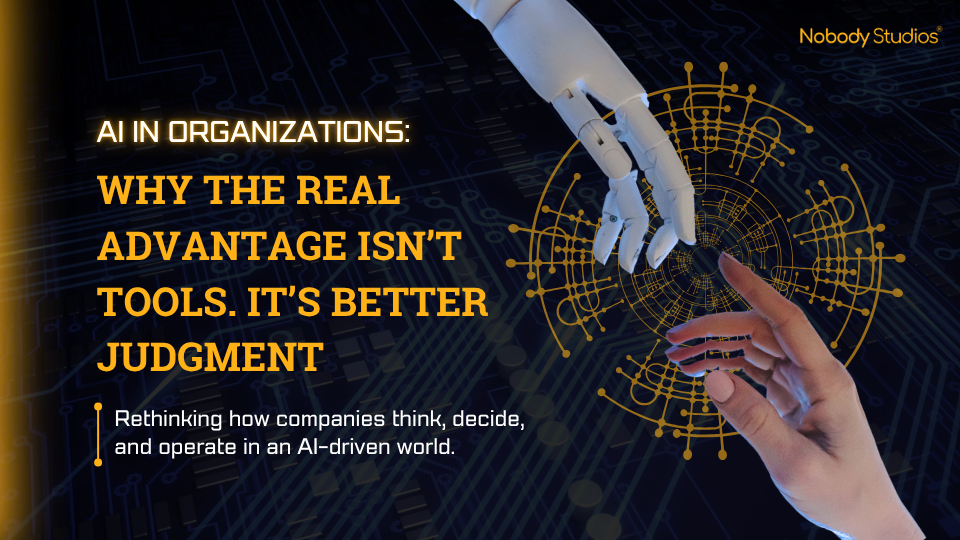

Most companies don’t have an AI problem.
They have a decision-making problem.
Despite an explosion of tools, data, and capabilities, many organizations are experiencing the opposite of what AI promised—slower decisions, more complexity, and increasing uncertainty. The issue isn’t access to intelligence. It’s the inability to effectively integrate that intelligence into how decisions are made.
This is where the real shift is happening.
The Illusion of More Tools = Better Outcomes
The default approach to AI adoption in organizations is predictable:
- Identify use cases
- Implement tools
- Train teams
- Expect results
But in practice, this often leads to fragmentation. Teams adopt different tools. Workflows become inconsistent. Outputs increase—but clarity doesn’t.
Why?
Because tools don’t solve for how decisions are made. They only amplify whatever system already exists.
If decision-making is slow, unclear, or overly dependent on hierarchy, AI will simply make those inefficiencies scale faster.
The Real Shift: From Tool Adoption to Operating Models
High-performing organizations are starting to approach AI differently.
Instead of asking, “What tools should we use?”
They’re asking, “How should we think, decide, and operate in an AI-enabled environment?”
This shift from tools to operating models is where real leverage is created.
AI becomes most valuable not when it automates tasks, but when it enhances how people think through problems, evaluate trade-offs, and make decisions under pressure.
Why Judgment Is the New Competitive Advantage
In an AI-driven organization, judgment becomes the differentiator.
Anyone can generate outputs.
Anyone can access data.
But not everyone can:
- Ask the right questions
- Interpret signals correctly
- Make decisions with speed and clarity
This is where organizations win or lose.
The leaders who succeed are not the ones who rely on AI for answers but those who use it to challenge assumptions, explore possibilities, and sharpen their thinking.
Learning Through Small, Continuous Experiments
One of the most effective ways to build this capability is surprisingly simple:
Start small.
Instead of large, top-down AI initiatives, leading operators are running small, low-risk experiments in their daily workflows:
- Using AI to prepare for key meetings
- Exploring different ways to analyze a dataset
- Testing how AI can support decision framing
These experiments aren’t about perfection—they’re about building tacit knowledge.
Over time, this creates something far more valuable than tool proficiency:
contextual understanding of what AI is good at—and where it falls short.
From Individual Learning to Organizational Capability
The next step is where most organizations fall short.
It’s not enough for individuals to experiment with AI. The learning needs to be:
- Shared
- Structured
- Embedded into workflows
When teams openly share what they’re learning:
- The stigma of “not knowing” disappears
- Collective intelligence increases
- Decision-making becomes more consistent
AI stops being a personal productivity tool and becomes part of the organization’s operating rhythm.
The Speed vs. Judgment Tradeoff Is a False Choice
Traditionally, organizations have had to choose:
- Move fast and risk poor decisions
- Move carefully and sacrifice speed
AI changes that equation.
When used effectively, it allows organizations to:
- Increase decision velocity
- Without sacrificing decision quality
But this only happens when AI is embedded into the thinking process, not just the execution layer.
What This Means for Leaders
The role of leadership is evolving.
It’s no longer about having all the answers.
It’s about creating an environment where better answers can emerge—faster.
This requires:
- Encouraging experimentation
- Creating space for reflection
- Building systems that support continuous learning
Leaders who succeed in this environment don’t position themselves as experts in AI.
They position themselves as learners in public—exploring, testing, and sharing what works.
Building an AI-Enabled Organization
Organizations that fully leverage AI tend to share a few characteristics:
- They prioritize thinking over tools
Tools are selected to support decisions—not the other way around. - They embed AI into daily workflows
Not as a separate initiative, but as part of how work gets done. - They scale learning, not just implementation
Knowledge is captured, shared, and reused across teams. - They treat AI as a collaborator, not a replacement
The goal is to enhance human judgment—not remove it.
The Bottom Line
AI is not just a technological shift.
It’s an operational shift.
The organizations that win won’t be the ones with the most advanced tools—
but the ones that build the strongest systems for thinking, deciding, and learning in an AI-enabled world.
Because in the end, AI doesn’t replace judgment.
It exposes it.
Further Reading
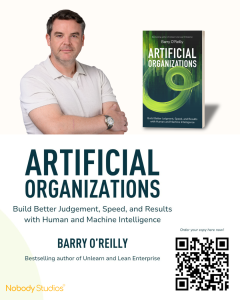 For leaders looking to go deeper into how decision-making, operating models, and AI intersect, Barry O’Reilly’s Artificial Organizations offers a practical perspective grounded in real-world applications across companies operating at scale.