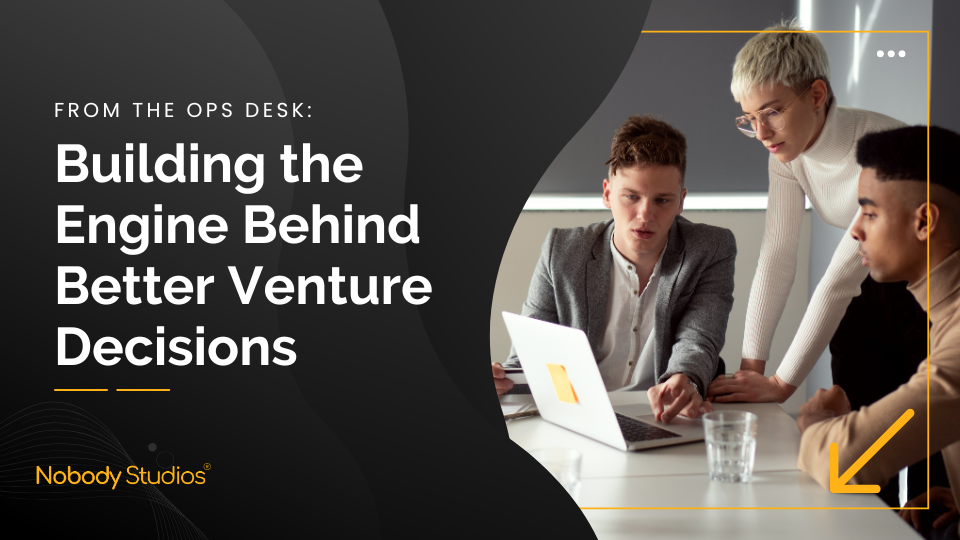

Most people see venture studios from the outside as places where big ideas become companies. From the operations seat, the work looks a little different.
A lot of my day is spent asking less glamorous but more important questions:
- Are we looking at the right opportunities?
- Are we learning from the work already happening inside the studio?
- Are we making decisions based on signal, or just momentum?
- And if a great idea appears twice, three times, five times across different conversations, will we actually catch it?
That last question has been on our minds a lot at Nobody Studios.
As we continue building alongside founders, partners, operators, investors, and AI consultants, we are exposed to a steady stream of potential venture ideas. Some come from market observations. Some come from customer pain. Some come from patterns inside consulting work, product builds, or operational bottlenecks. The challenge is not that we lack ideas. The challenge is that ideas can be noisy.
So we’ve been building something internally that we’re excited about: an AI-enabled Venture Idea and Evaluation Engine.
At a practical level, it gives us a structured way to collect, analyze, score, and compare new venture ideas. Partners can submit ideas based on real client work. The system then helps us evaluate whether the problem is repeated, whether someone is already paying to solve it, whether the solution has a meaningful AI component, whether it is defensible, and whether it fits the strengths of the studio.
But the bigger operational benefit is that it turns scattered insight into a repeatable operating system.
Instead of ideas living in Slack threads, call notes, founder conversations, or someone’s memory, they become structured records. Each one can be researched, scored, compared, revisited, and connected to similar patterns over time. The engine creates a dashboard view of the studio’s opportunity pipeline, with clear recommendations and supporting decision memos. That means we can spend less time asking, “What was that idea again?” and more time asking, “What should we do about it?”
This also creates a strategic advantage for the studio.
A venture studio’s edge is not just having creative ideas. It is building the muscle to repeatedly identify the right ones earlier, pressure-test them faster, and allocate attention more intelligently. Our evaluation engine helps us do exactly that. It gives us a shared language for what makes an opportunity worth pursuing: real pain, clear buyer demand, repeatability, execution feasibility, market openness, internal fit, risk profile, and defensibility.
And because we are Nobody Studios, we are also asking a more specific question: is this a defensible AI opportunity?
In other words, is this the kind of AI business that is valuable because the real world is messy? Does it require integrations, operational nuance, workflow depth, trust, compliance, data gravity, or distribution advantages? Is it more than a thin wrapper on top of a model? Is it the kind of company that becomes stronger because it solves a difficult, specific, real-world problem?
Those are the opportunities we want to understand deeply.
For operations, the benefit is clarity. The system helps us move from subjective enthusiasm to structured conviction. It does not replace human judgment. It sharpens it. It gives the team a first pass, a second pass, and a consistent way to see what deserves real discussion.
For investors, it gives visibility into how we reduce venture risk before committing resources.For entrepreneurs, it shows how we think about building companies from evidence, not hype.For talent, it reflects the kind of environment we are creating: one where ideas are welcomed, but rigor is expected.
This is also part of a larger commitment at Nobody Studios: being AI-first in everything we do.
That does not mean using AI as a gimmick. It means looking at every recurring workflow inside the studio and asking whether intelligence, automation, and structured data can make it better. Recruiting, research, diligence, product strategy, partner operations, venture evaluation — all of it is being reimagined through an AI-first lens.
The venture idea engine is one example of that ethos becoming operational…
- It helps us move faster without becoming careless.
- It helps us scale judgment without flattening nuance.
- It helps us turn collective intelligence into a studio asset.
And maybe most importantly, it helps us stay honest.
Because in venture building, the question is not simply, “Is this interesting?”
The better question is:Is this real enough, painful enough, defensible enough, and aligned enough that Nobody Studios should spend its time helping bring it to life?That is the kind of question worth building a system around.