
The fear of technology taking human jobs is as old as industry itself. When automated looms arrived in the 19th century, Luddites destroyed machines in protest. When computers entered offices in the 1980s, critics predicted the death of white-collar employment. Today, generative AI and autonomous agents have reignited that concern.
The fundamental question facing leaders and workers alike is straightforward: Will companies hire fewer people in the AI era?
The short answer is: Yes, for specific task-execution roles—but no, for total aggregate workforce value.
Rather than ushering in an era of mass unemployment, AI is driving a profound structural shift. The total number of jobs may not shrink dramatically, but what companies hire for, how teams are structured, and the speed at which headcount scales will change forever.
1. The Death of the “Linear Headcount” Model
Historically, business growth had a linear relationship with headcount. If a software company wanted to double its customer base, it had to double its customer support representatives, expand its sales team, and hire dozens of QA engineers.
AI breaks this formula through super-linear scaling. Automated workflows, custom AI agents, and natural language interfaces allow a team of 10 people to produce output that previously required 50.
| Traditional Scaling Model | AI-Augmented Scaling Model |
| Headcount grows proportionally with revenue. | Revenue scales rapidly while headcount grows selectively. |
| Time is spent on routine execution and data entry. | Time is spent on strategy, validation, and curation. |
| Output is constrained by human labor hours. | Output is constrained by strategy, compute, and data quality. |
| Entry-level staff handle repetitive task production. | AI agents handle task execution; staff review and refine. |
Instead of hiring fewer people overall, fast-growing companies are achieving significantly higher output per employee, shifting their budgets from sheer labor volume toward high-capability talent and AI infrastructure.
2. The Economic Paradox: Substitution vs. Augmentation
To understand why widespread job destruction isn't the primary outcome, we have to look at how economics views labor automation:
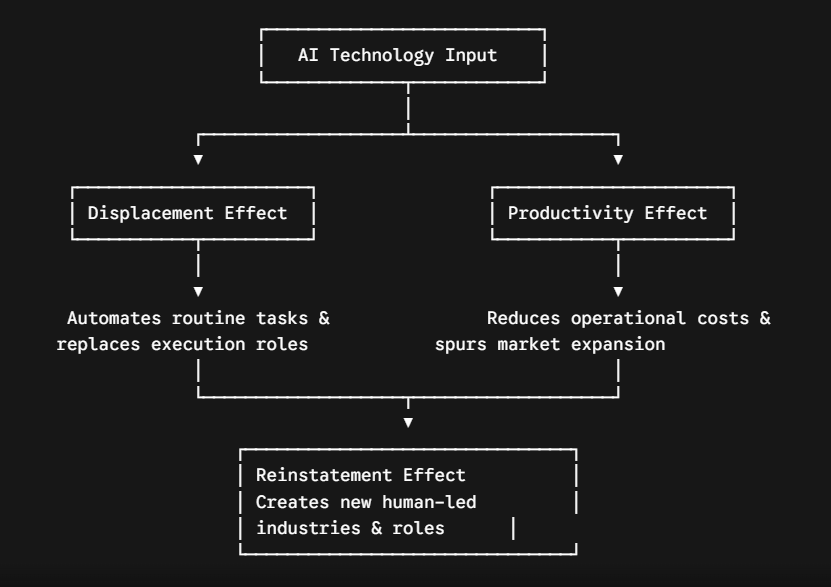
- The Displacement Effect: AI directly replaces humans in routine, highly structured, or repetitive cognitive tasks (e.g., basic data extraction, initial code generation, frontline tier-1 support).
- The Productivity Effect: By lowering operational costs, products become cheaper and better. This creates higher demand, allowing companies to expand into new markets and invent new product lines that require human oversight.
- The Reinstatement Effect: The creation of new technologies demands entirely new categories of human work that didn't exist a decade ago—such as AI trust & safety officers, prompt engineers, and machine learning operations specialists.
Economic history demonstrates that the productivity and reinstatement effects generally outweigh displacement over the long term.
3. Where Hiring Will Decrease (The Attrition Zones)
While aggregate employment shifts, specific categories face direct hiring reductions. Companies are slowing hiring or downsizing in three main areas:
High-Volume, Low-Complexity Cognitive Work
Roles focused on aggregating, transcribing, or categorizing data are being automated rapidly.
- Examples: Basic data-entry clerks, entry-level copywriters, tier-1 IT helpdesk, basic translation services.
Pure Execution Roles
In fields like software development or graphic design, the demand for “pure execution” (turning a completed spec into standard code or making minor design variations) is falling. Fewer junior coders are needed to write boilerplate code when an AI copilot can generate thousands of lines in seconds.
Middle-Management Data Aggregators
Historically, a major function of middle management was collecting status updates from frontline workers and reporting them up the chain. AI dashboards and autonomous task trackers handle status synthesis automatically, allowing companies to operate with flatter organizational structures.
4. The Squeeze on Early-Career Talent
The most critical challenge of the AI hiring landscape isn't overall job loss—it's the compression of the entry-level talent pipeline.
Traditionally, entry-level workers learned their industry by performing the high-volume, routine tasks that AI now automates. As companies hire fewer junior staff for execution, they face a new dilemma: How do you train the senior experts of tomorrow if you eliminate the entry-level jobs of today?
Forward-thinking companies are adapting by redefining entry-level roles. Rather than doing the manual work, junior employees are being trained as “AI operators” who orchestrate automated systems and review outputs for strategic alignment.
5. What Capabilities Companies Value Most Now
As the cost of raw execution drops to near zero, the premium on uniquely human capabilities rises. Organizations are pivoting their hiring toward individuals who possess:
- Problem Formulation over Execution: Knowing what problem to solve and how to ask the right questions is becoming far more valuable than simply executing a predetermined recipe.
- Systemic and Strategic Thinking: Evaluating how different parts of a business, technical architecture, or market interact when AI handles the underlying execution.
- Domain Expertise and Curation: AI models output plausible-sounding information that can be subtly wrong. High-value employees are those with deep domain knowledge who can audit, curate, and guarantee quality.
- High Emotional Intelligence (EQ): Persuasion, stakeholder management, cross-functional collaboration, and ethical leadership remain resistant to automation.
How Professionals and Organizations Must Adapt
For Organizations
- Rethink Early-Career Development: Don't stop hiring entry-level talent. Redesign junior positions so new hires learn critical thinking and AI orchestration from day one.
- Upskill the Existing Workforce: Retraining an employee who understands your company's culture and domain is consistently more cost-effective than competing for scarce external AI talent.
- Focus on Reinvestment: Use the efficiency gains from AI to launch new initiatives and improve customer experiences, rather than treating AI solely as a headcount-reduction tool.
For Individuals
- Become an AI Operator: Learn to use modern AI tools to amplify your output, regardless of your field.
- Deepen Your Domain Knowledge: Move beyond basic execution to understand the why behind your industry's decisions.
- Invest in Human-Centric Skills: Develop capabilities in leadership, negotiation, complex negotiation, and empathetic communication—skills that software cannot replicate.
Companies will not hire fewer people simply to operate with empty offices. Instead, they will hire fewer people to do task execution and more people to drive strategic expansion, creative innovation, and human connection.