
When Marc Andreessen famously declared in 2011 that “Software is eating the world,” it kicked off a decade-long land grab. Suddenly, pizza delivery businesses became logistics-software platforms, banks morphed into mobile app ecosystems, and fitness brands refactored as connected digital communities.
Today, we are witnessing the second, far more radical phase of that transformation: AI is eating software.
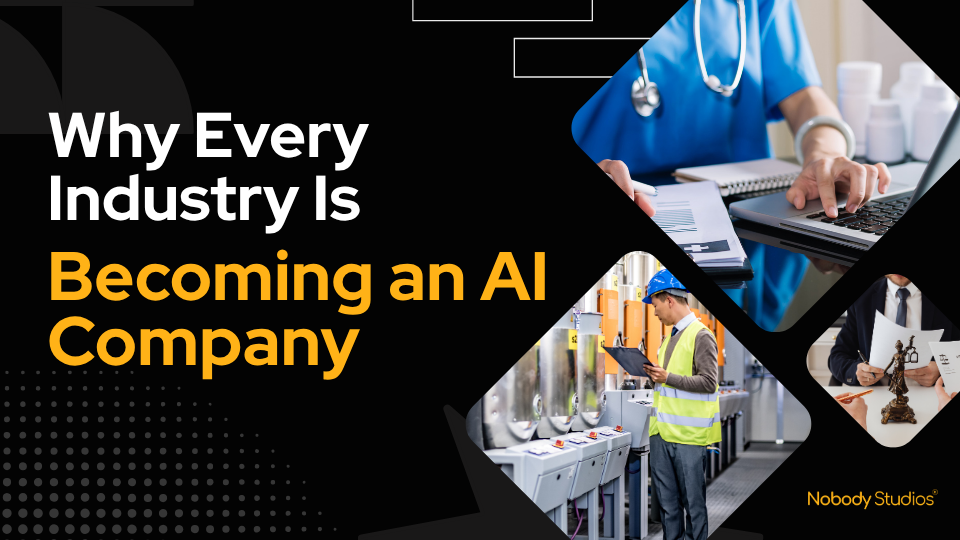
The transition from software-enabled to AI-native execution means that every industry—regardless of physical tangible output—will operate as an AI company. This doesn't mean a bricklayer will stop laying bricks or a surgeon will stop performing operations; it means the competitive engine driving the strategy, economics, margin profile, and scale of those operations will be fundamentally autonomous and data-driven.
1. The Anatomy of the Transformation
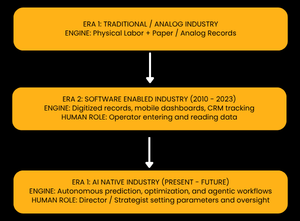 To understand why traditional industries are shifting, we must look at how technology has traditionally integrated into non-tech sectors versus how AI integrates.
In Era 2, software digitized record-keeping. In Era 3, AI digitizes cognition and execution.
2. Sector-by-Sector Breakdown
Here is how the underlying business model and operational framework shifts across non-software industries:
 Construction: From Manual Scheduling to Autonomous Site Orchestration
- The Old Paradigm: Job-site delays, safety hazards, and material waste managed through static spreadsheets and manual site inspections.
- The AI-Native Reality: Drones equipped with computer vision continuously capture site geometry to automatically update BIM (Building Information Modeling) systems. AI agents dynamically re-route material deliveries based on weather and labor constraints, predict structural stress points before pouring concrete, and prevent budget overruns dynamically.
 Healthcare: From Symptom Reaction to Predictive Diagnostics
- The Old Paradigm: Physicians manually reviewing scans, updating EHRs (Electronic Health Records), and diagnosing based on individual clinical experience.
- The AI-Native Reality: Hospital networks operating proprietary models trained on multi-modal patient data. AI algorithms screen medical imagery faster than human eyes, synthesize genome sequencing, and draft personalized treatment plans—freeing clinicians to focus entirely on direct patient care and ethical judgment.
 Manufacturing: From Scheduled Maintenance to Self-Healing Supply Chains
- The Old Paradigm: Fixed maintenance schedules, factory downtime, and manual quality assurance spot-checks.
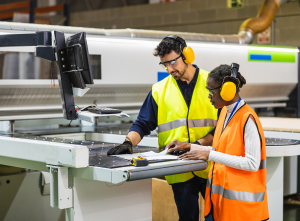
- The AI-Native Reality: IoT sensors feeding real-time vibration and thermal telemetry into custom predictive AI models. Machines schedule their own repair cycles during low-demand hours, and vision models inspect 100% of manufactured parts on the line at millisecond speeds.
 Retail: From Inventory Management to Individualized Demand Engines
- The Old Paradigm: Buying seasonal inventory based on historic trends and running mass marketing promotions.
- The AI-Native Reality: Autonomous supply networks that adjust micro-inventory levels in real time based on local hyper-trends, social media sentiment, and weather patterns. Dynamic pricing models and generative interfaces create individual, personalized storefronts for every shopper.
 Agriculture: From Broad Yield Estimation to Micro-Plot Automation
- The Old Paradigm: Spraying entire fields with pesticides and relying on macro-weather forecasts.
- The AI-Native Reality: Computer-vision-guided tractors targeting individual weeds with targeted micro-doses of herbicide, saving up to 90% of chemical input. AI satellite models analyze soil nitrogen levels to optimize yields per square meter autonomously.
 Law & Professional Services: From Hourly Research to Real-Time Strategy
- The Old Paradigm: Junior associates spending hundreds of hours reading case history, conducting discovery, and drafting boilerplate contracts.
- The AI-Native Reality: Law firms building proprietary vector databases on top of decades of internal firm knowledge. AI agents run instant Freedom to Operate (FTO) searches, draft preliminary briefs, and highlight risk parameters in seconds—shifting the firm's core economic value from hours billed to outcomes delivered.
3. Why Non-Tech Industries Have No Choice
The migration of non-software industries into AI-native companies is driven by three inescapable economic forces:
1. The Shift to “Cognitive Margins”
In traditional services and physical industries, revenue scales linearly with headcount. To build more, clean more, or advise more, you must hire more. AI decouples revenue from headcount, allowing traditional businesses to achieve software-like gross margins by automating repetitive administrative and operational heavy lifting.
2. Real-World Data is the Ultimate Moat
Off-the-shelf public AI models are commoditized—anyone can access them. However, real-world operational data (e.g., 20 years of hospital patient outcomes, proprietary crop yield telemetry, or site logs from thousands of construction projects) cannot be scraped off the public web. Traditional companies that feed their proprietary operational context into AI models build defensible moats that competitors cannot recreate.
3. Speed Is the Core Competitive Advantage
When two companies in the same traditional market offer comparable physical products, the one using AI internally to test, iterate, price, and execute faster will inevitably capture market share. The advantage isn't just what you build—it's how fast you operate.
4. What Makes an “AI-Native” Company in Any Industry?
Becoming an AI company doesn't require building foundational LLMs from scratch. Instead, it means transforming the core operating architecture around four questions:
- Data Accumulation: What proprietary operational data are we collecting every day that no one else has?
- Workflow Automation: Which internal processes are still limited by manual human speed rather than human judgment?
- Customer Interface: Are we forcing our customers through static linear channels, or providing dynamic, personalized experiences?
- Defensibility: If a competitor bought our physical assets tomorrow, what institutional intelligence would they still fail to replicate?
The divide of the next decade will not be between “tech companies” and “traditional companies.” It will be between companies that use AI to drive their operational execution and those that get left behind by competitors who do.