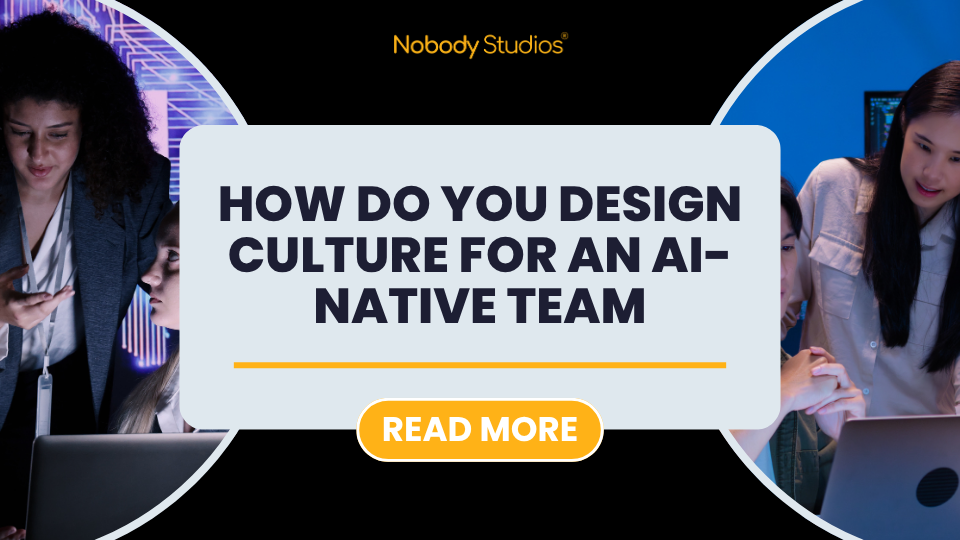

When a company scales to millions in revenue with only a handful of human employees, the traditional corporate culture playbook completely shatters. In a hyper-lean, AI-native organization, talent management isn't about managing headcount—it’s about nurturing an elite core of systems architects, creative directors, and ultimate decision-makers.
Here is a structural breakdown of organizational culture and retention strategies designed specifically for the AI-native era.
-
The Cultural Pillars of AI-Native Teams
Traditional corporate culture often rewards visible busyness, political maneuvering, and managing large teams. AI-native culture actively rejects this, anchoring itself on three distinct pillars:
Intent Clarity Over Execution Velocity
In an environment where AI executes code, designs layouts, and parses data in seconds, the human bottleneck is no longer speed—it is direction. The culture must value people who can articulate exceptionally precise, ambitious, and ethically sound prompts and system architectures.
Radical Autonomy and Extreme Ownership
With flat organizations, there is no room for micromanagement or multi-layered approval chains. Employees operate like internal founders. Culture is built around extreme trust, where individuals are given full ownership of entire product ecosystems or business outcomes, relying on their personal suite of AI agents to deliver.
Continuous Unlearning
Because the capabilities of underlying AI models shift rapidly, technical dogmatism is a liability. The cultural premium is placed on cognitive flexibility—the willingness to abandon a workflow or codebase that took months to build the moment a more efficient AI framework renders it obsolete.
-
Talent Retention Strategies for the Elite Few
When a hyper-lean company loses just one key employee, it doesn’t just lose its workforce; it might lose its human institutional knowledge. Retention in these companies requires a radical rethink of compensation and career trajectory.
The “Sovereign Operator” Equity Model
Standard, slowly-vesting stock options aren't enough to retain elite talent who could easily build competitive software themselves using modern AI tools. AI-native companies must offer:
- High-Upside Profit Sharing: Direct ties between the automated efficiency of the systems an employee designs and their financial payout.
- Founding-Level Equity: Treating early employees more like co-founders than staff, acknowledging that their leverage scales the company exponentially.
Replacing the Management Track with the “Leverage Track”
In traditional companies, the only way to progress your career and earn more money is to manage more people. In an AI-native company, that track doesn't exist. Instead, retention relies on mapping career growth to technological leverage.
Traditional Career: Junior Exec –> Manager –> Director (More People)
AI-Native Career: Architect –> Strategist –> Principal (More Agentic Leverage)
Employees are promoted based on the complexity, scale, and efficiency of the autonomous systems and multi-agent workflows they oversee, allowing them to remain high-impact individual contributors without forcing them into people-management roles they may not want.
Guarding Against “Agentic Burnout”
While cognitive offloading to AI reduces tedious work, it drastically increases the time humans spend on high-consequence, deeply analytical, and creative tasks.
- The Reality: Spending 8 hours a day purely making critical strategic decisions and analyzing edge cases is mentally exhausting.
- The Retention Fix: Companies must mandate aggressive cognitive downtime. Retention strategies include radical asynchronous work environments, strict boundaries around human-to-human deep-work hours, and treating mental rest as a required maintenance protocol for the company's most valuable asset: human judgment.
-
The Interview Framework for AI-Native Talent
You cannot interview an AI-native operator using standard behavioral questions or rote technical tests. To find and retain the right culture fits, interviews must evaluate a candidate's relationship with technology.
| Evaluated Skill | Traditional Interview Method | AI-Native Interview Method |
| Problem Solving | “Write a script to solve X problem from scratch.” | “Here is a broken codebase generated by an AI. Find the logical flaw in its architectural assumptions.” |
| Resourcefulness | Testing memory of syntax and frameworks. | Observing how efficiently they prompt, orchestrate, and course-correct an unfamiliar AI tool to solve a novel problem. |
| Vision & Strategy | Assessing their willingness to follow a rigid, preset product roadmap. | Asking them to define what problem a business should solve next, and mapping out the multi-agent system required to execute it. |
The Golden Rule of AI-Native Retention:
You aren't hiring people to fill boxes on an org chart. You are partnering with high-leverage individuals to build a self-sustaining engine. If your culture treats them like cogs, they will simply use AI to build their own engine somewhere else.
The transition to an AI-native company isn't just an upgrade to your tech stack—it’s a fundamental overhaul of the human contract at work. As autonomous systems take over the burden of execution, the value of human talent doesn't diminish; it concentrates. The organizations that win the next decade won't be those that use AI to squeeze more labor out of traditional org charts. They will be the ones that build a culture around intent, autonomy, and extreme technological leverage—giving elite operators a reason to stay, build, and scale the future.