
For decades, the standard recipe for launching a software company followed a rigid blueprint: raise seed capital, hire a CTO, build an engineering team, spend six months writing code, and pray that market demand existed once the product shipped.
Syntax was the ultimate moat. Writing reliable backend logic, wiring up database pipelines, and constructing front-end interfaces required specialized, hard-earned labor.
That leverage has inverted.
With modern LLMs and agentic workflows driving software generation, writing syntax is shifting from a high-value bottleneck to a low-cost commodity. The primary bottleneck is no longer how to build, but what to build, why it matters, and who will pay for it.
We are witnessing a fundamental career and economic migration: the shift from coding to company building.
The Compression of the Technical Moat
Historically, technical moats were built on execution friction:
- Writing scalable boilerplate code
- Configuring complex cloud infrastructure
- Manually wiring API integrations
- Navigating syntax edge cases and language frameworks
AI development tools don’t just speed up these processes—they collapse them. Tasks that once required a sprint team of four engineers over three weeks can now be architected and deployed by a single developer guiding AI agents in an afternoon.
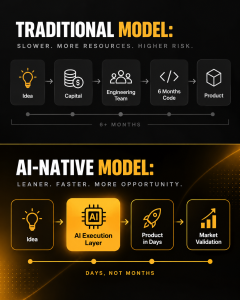
When software creation costs trend toward zero, code itself ceases to be a primary competitive advantage. The moat moves upstream to problem selection, distribution, data loops, and brand trust.
The Rise of the “Product Architect”
As AI handles syntax generation, the role of the software developer is evolving into that of a system editor and company builder.
Rather than spending hours writing CRUD operations, builders act as product architects, focusing on four core dimensions:
1. Problem Decomposition over Syntax Memory
The defining skill of modern engineering isn’t memorizing syntax or algorithms. It is the ability to break complex real-world business problems down into clear, deterministic logic gates and prompts that AI agents can execute reliably.
2. Architectural Governance
AI can output thousands of lines of functional code in seconds. However, managing trade-offs, preventing technical debt, ensuring security compliance, and maintaining data schema integrity require deep human judgment. The engineer shifts from a factory worker to a site foreman.
3. Distribution-First Thinking
In a world oversaturated with software, building a great product is only 20% of the battle. The remaining 80% relies on distribution channels, go-to-market strategies, and user acquisition dynamics. Technical builders are forced to acquire founder-level skills early in their careers.
4. Unit Economics & Business Logic
When building software requires compute tokens rather than purely fixed developer salaries, understanding API margins, infrastructure cost curves, and customer acquisition costs (CAC) becomes an immediate technical consideration, not an afterthought.
From Developer to Solo Founder: The One-Person Unicorn Paradigm
The lowering of technical barriers has birthed a new organizational species: the hyper-leveraged small team.
| Metric | Traditional Software Startup (Pre-AI) | AI-Native Startup |
| Team Size at Launch | 5–12 employees | 1–3 builders |
| Primary Bottleneck | Engineering capacity & headcount | Strategy, distribution, & market fit |
| Time to MVP | 3 to 6 months | Days to weeks |
| Capital Requirement | High (Institutional Seed Round) | Low (Bootstrapped or Micro-Seed) |
| Focus | Writing clean, scalable code | Solving customer pain points & retention |
With AI handling customer support initial triage, content generation, boilerplate creation, and automated testing, solo founders can now operate with the operational breadth that previously required an entire seed-stage company.
How to Adapt: Transitioning Your Mindset
If you are a developer, designer, or tech worker looking to thrive in this new landscape, your career playbook must change.
- Stop Measuring Output by Lines of Code: Shift your metric of personal success from features shipped to business outcomes created (e.g., revenue generated, churn reduced, user onboarding time cut).
- Learn the Business Stack: Familiarize yourself with sales funnels, financial modeling, positioning, copy performance, and unit economics.
- Master AI Orchestration: Treat AI models as mid-level junior developers. Focus on prompt clarity, system constraints, testing frameworks, and output validation.
- Build in Public & Own Distribution: Create a personal brand, build an audience, and engage directly with potential users. Distribution is the ultimate insurance policy against automation.
The Bottom Line
AI hasn’t killed software engineering—it has liberated it.
By removing the manual friction of code generation, technology has unlocked the ability for every developer to think, act, and execute like a CEO. The future doesn’t belong to those who can write the cleanest function; it belongs to those who can leverage intelligent systems to solve real human problems and turn those solutions into sustainable businesses.