
For decades, the software paradigm was simple: humans provided the intelligence, and tools provided the execution. A spreadsheet didn’t analyze financial data; an analyst used the spreadsheet. A CRM didn’t manage customer relationships; a sales representative operated the database. Software was purely reactive—a static utility waiting for human input.
That paradigm has officially broken.
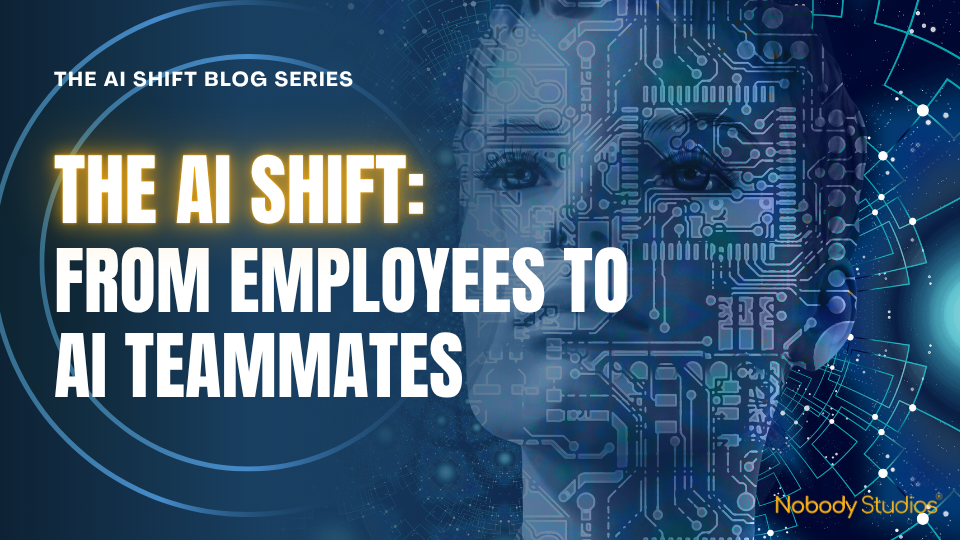
We have entered a fundamental transition in how organizations operate: The Shift from Software as a Tool to AI as a Teammate.
AI is no longer just an assistant drafting an email or generating a quick summary. It is evolving into autonomous software agents capable of executing multi-step workflows, holding context, making probabilistic decisions, and collaborating directly alongside human professionals.
To thrive in this new landscape, business leaders and founders must stop viewing AI as a simple productivity feature and start integrating AI as an active, agentic member of the workforce.
1. Defining the Shift: Tools vs. Assistants vs. Teammates
To understand how workforce architecture is evolving, we must map out the three distinct eras of workplace technology:
| Capability Era | Interaction Model | Functionality | Primary Value |
| Era 1: Software Tools | Input ➔ Output | Static execution of programmed rules (e.g., Excel, Salesforce). | Speed & Accuracy |
| Era 2: AI Assistants | Prompt ➔ Response | Generative assistance requiring constant human guidance (e.g., standard Copilots). | Time Reduction |
| Era 3: AI Teammates | Goal ➔ Autonomous Action | Agentic workflows with reasoning capabilities, context, and multi-step execution. | Expanded Capacity & Leverage |
An AI Assistant waits for you to give it a task, does the draft, and gives it back to you.
An AI Teammate understands the strategic objective, monitors inputs continuously, collaborates asynchronously, makes contextual choices within guardrails, and asks for human intervention only when necessary.
2. The Mechanics of an AI Teammate: The Agentic Stack
What transforms an AI model into a functional workplace collaborator? An AI teammate requires an enterprise framework built on four core capabilities:
A. Persistent Memory & Context
Traditional AI sessions reset after every interaction. An AI teammate retains long-term memory across projects, learning company style guides, historical client preferences, past decisions, and institutional knowledge over time.
B. Systemic Integration & Tool Use
An AI teammate doesn’t live solely inside a chat window. It possesses API access to your company’s core operational stack—Slack, GitHub, HubSpot, Jira, or Google Workspace—allowing it to read data, write reports, trigger actions, and update records across systems.
C. Reasoning & Multi-Step Execution
When given a high-level goal (e.g., “Audit our Q3 customer churn and prepare an intelligence summary”), an AI teammate breaks the directive down into sub-tasks:
- Pulling user usage logs from the database.
- Filtering for churned accounts.
- Cross-referencing support ticket sentiment.
- Synthesizing key patterns.
- Drafting a presentation for human review.
D. Human-in-the-Loop Guardrails
An effective AI teammate understands its operational limits. It executes lower-risk routine tasks autonomously while automatically escalating high-stakes decisions (e.g., issuing refunds over a certain threshold, publishing customer-facing messaging) to human approval.
3. How AI Teammates Function Across Key Business Units
Integrating AI teammates isn’t about reducing headcount; it’s about dramatically increasing company leverage. Here is how agentic collaboration looks across key operational functions:
Engineering & Product
- Old Model: Developers spend 40% of their time writing code and 60% managing documentation, writing unit tests, and debugging.
- AI Teammate Model: An AI developer agent continuously monitors the codebase, automatically writes test suites for new pull requests, flags security vulnerabilities in real-time, and drafts release documentation—allowing engineers to focus purely on architecture and product strategy.
Customer Success & Support
- Old Model: Tier 1 support reps manually clear repetitive tickets, escalating complex issues to senior support engineers.
- AI Teammate Model: An AI support agent acts as a Tier 1 team member. It accesses customer account history, resolves multi-step issues (like processing returns or modifying account parameters directly in the backend), and hands off intricate edge-cases to human reps alongside a complete context summary.
Marketing & Growth
- Old Model: Growth teams manually aggregate campaign metrics, write copy variations, and adjust ad spend across multiple platforms.
- AI Teammate Model: An AI growth manager tracks ad performance across channels 24/7, flags low-performing creative assets, generates updated visual and text variations based on high-performing copy, and submits budget adjustments for human sign-off.
4. The Human Element: Managing a Hybrid Workforce
The transition from employees using tools to employees managing AI teammates requires a fundamental culture shift. The primary competitive skill for knowledge workers in the AI era is changing: it is shifting from technical execution to management, orchestration, and domain expertise.
To build a high-performing hybrid team, organization leaders must focus on three core management shifts:
- From Prompting to Managerial Delegation: Instead of learning hyper-specific text prompts, workers must learn how to define clear outcomes, establish clear operating parameters, and provide constructive feedback on agent outputs.
- Establishing Systemic Trust: Leaders must set up transparent audit trails. You shouldn’t trust an AI teammate blindly; you trust it because its step-by-step reasoning and system logs are fully visible and auditable.
- Cultivating High-Touch Human Value: When AI handles the heavy lifting of analytical data processing and routine execution, human teammates are freed to double down on creative vision, high-stakes negotiation, client empathy, and strategic intuition.
Summary Checklist: Preparing Your Organization for AI Teammates
To successfully transition your team into an agent-supported enterprise, implement this step-by-step framework:
| Phase | Strategic Focus | Action Item |
| Phase 1: Task Audit | Map Workflows | Identify high-volume, repeatable processes ripe for multi-step agent execution. |
| Phase 2: Context Layer | Unify Knowledge | Consolidate internal documentation, SOPs, and data silos into clean knowledge bases (RAG). |
| Phase 3: Integration | Connect APIs | Grant AI agents read/write capabilities across operational systems with strict security permissions. |
| Phase 4: Governance | Set Guardrails | Define strict parameters for autonomous action vs. mandatory human escalation. |
| Phase 5: Upskilling | Shift Mindsets | Train existing staff on workflow orchestration, agent management, and quality control. |
The Path Forward
The winning companies of the next decade will not necessarily be the ones with the largest budgets or the highest headcount. They will be the leanest, most agile organizations that master the art of human-AI collaboration.
By treating AI as an active teammate rather than a passive utility, companies can unlock unprecedented operational leverage—allowing small teams to execute with the power, scale, and output of massive global enterprises.