
For nearly three decades, Software-as-a-Service (SaaS) reigned supreme as the default distribution model for digital tools. It promised recurring revenue for vendors and cloud-hosted convenience for users. Yet, despite its success, traditional SaaS built its fortune on a structural inefficiency: it made humans do the labor.
Conventional SaaS applications are passive databases wrapped in graphical user interfaces (GUIs). To generate value from a CRM, an ERP, or a marketing platform, a human must click buttons, fill out text fields, route information between tabs, and interpret outputs. In essence, traditional SaaS functions like a digital filing cabinet.
We are now undergoing a fundamental paradigm shift. As foundational AI models advance from simple text generators to autonomous execution engines, the software industry is transitioning from static SaaS platforms to dynamic, Intelligent Systems.
The Core Evolution: Database with a UI vs. Autonomous Engine
To understand why this shift is rewriting the rules of software economics, we must analyze how the fundamental unit of value is changing.
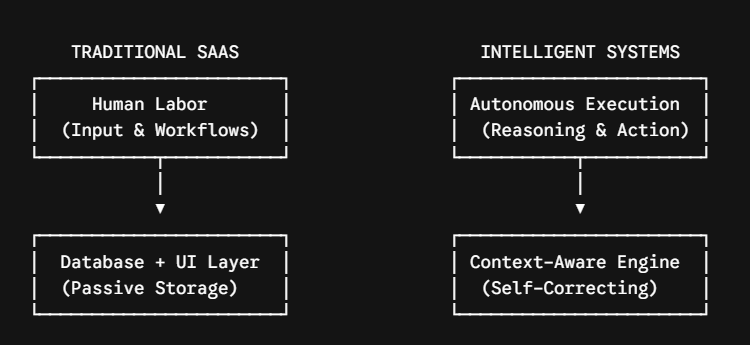
The difference comes down to three architectural shifts:
- From Record-Keeping to Direct Action: Traditional SaaS relies on the user to create records, update statuses, and move data from point A to point B. An Intelligent System monitors data streams, detects anomalies or opportunities, formulates a plan, and executes the necessary API calls autonomously.
- From Rigid Logic to Contextual Reasoning: SaaS operates strictly on deterministic if/then rules configured by IT administrators. Intelligent Systems utilize probabilistic reasoning grounded in enterprise data—adapting flexibly to ambiguous edge cases, messy inputs, and changing business environments.
- From Per-Seat Pricing to Work-Based Value: Because SaaS sells access to a UI, it charges on a per-user, per-month seat basis. Intelligent Systems perform actual work, shifting economic models toward value metrics such as outcome-based pricing, work-completed units, or API resolution volume.
The Four Architecture Pillars of an Intelligent System
Transforming a static application into an adaptive Intelligent System requires moving beyond simple API integrations with foundation models. It demands a multi-layered architectural stack:
| Layer | System Function | Operational Mechanics |
| 1. System-of-Record Integration | Data Connectivity | Ingests real-time events and data state from enterprise databases, APIs, legacy ERPs, and cloud storage. |
| 2. Context & Memory Infrastructure | Long-Term State | Uses vector storage, knowledge graphs, and relational caching to give the system persistent memory of past actions and organizational rules. |
| 3. Cognitive / Reasoning Layer | Decision Making | Dynamically routes prompts through LLMs, SLMs (Small Language Models), or deterministic heuristics based on cost, latency, and task complexity. |
| 4. Action & Tool-Use Engine | Execution | Uses structured tool calling (APIs, webhooks, RPA bots) to write back to systems, send communications, or trigger business operations. |
| 5. Human-in-the-Loop Governance | Control & Auditability | Sets permission guardrails, policy enforcement checks, and escalation paths to request human approval when confidence scores fall below defined thresholds. |
Architectural Deep Dive: Moving from Prompts to Autonomous Loops
Building a true Intelligent System requires moving away from single-shot prompt-and-response paradigms and toward closed-loop agentic architectures. Below is the technical execution pattern for an autonomous system handling complex enterprise workflows.
1.Context Retrieval & Environment Ingestion: Establish the state of the system.
The system continuously listens to environment triggers (such as an incoming customer ticket, a database event, or a scheduled cron job). It pulls relevant unstructured domain knowledge via retrieval-augmented generation (RAG) alongside structured context from enterprise relational databases.
2.Task Decomposition & Planning: Break complex goals into execution steps.
Rather than attempting single-pass generation, the cognitive engine decomposes the high-level goal into a graph of sub-tasks. It determines dependencies, validates necessary tool permissions, and selects the optimal path for execution.
3.Tool Execution & State Mutation: Execute actions via deterministic APIs.
The engine calls external tools, APIs, and microservices to carry out the planned sub-tasks. It handles authentication, validates payload schemas, and records state changes directly back into systems of record.
4.Verification & Self-Correction: Evaluate results against goal constraints.
After executing actions, the system inspects the output against deterministic validation logic. If an API fails or an output violates business constraints, the engine reflects on the error, modifies its execution plan, and attempts self-correction before escalating.
Comparison: The SaaS vs. Intelligent Systems Paradigm
| Operational Metric | Legacy SaaS | Intelligent Systems |
| Primary Value Asset | User Interface (UI) & Data Storage | Outcome Quality & Autonomous Throughput |
| User Interaction | Point-and-click navigation | Goal specification & oversight |
| System Behavior | Deterministic rule processing | Probabilistic reasoning & adaptive planning |
| Monetization Model | Per-Seat / Per-Month subscriptions | Value-based, per-outcome, or per-resolution billing |
| Switching Costs | High due to user interface training and data lock-in | High due to embedded operational history and contextual adaptation |
The Strategic Path Forward for Builders and Leaders
Transitioning from a traditional software vendor to an Intelligent System provider requires rethinking product strategy from the ground up:
- Stop Building Interfaces; Start Building Workflows: Measure software value by the amount of human labor removed from a task rather than the number of daily active users spending hours inside a UI.
- Prioritize Deterministic Safety: Generative flexibility must be paired with strict system guardrails. Implement robust audit logging, deterministic schema verification, and clear fallback pathways for human intervention.
- Capture Contextual Exhaust: The long-term moat of an Intelligent System is its cumulative operational history. Systems that learn how an enterprise operates over time become virtually impossible to replace.
The software landscape is shifting from tools that humans use to accomplish work, to intelligent environments that perform the work alongside humans. The companies that navigate this transition will not merely update their software stack—they will redefine the economics of enterprise productivity.