

For the last two decades, the venture capital playbooks that built Silicon Valley revolved around a single, highly inefficient ritual: the search for needle-in-a-haystack founders.
An investor sits through hundreds of pitches, funds one or two bets out of a hundred, and hopes that a tiny, scrappy team can navigate product-market fit before running out of cash. The traditional startup journey was a brutal game of exhaustion—founders spent 80% of their time hiring generalists, fundraising, setting up basic infrastructure, and fighting operational friction, leaving only 20% for actual product strategy and customer empathy.
AI is turning that equation completely on its head.
We are stepping out of the era of point-solution startups and entering the era of Venture Factories (or AI-native Venture Studios)—institutions designed to ideate, validate, build, and scale multiple companies simultaneously using shared AI leverage.
1. Why the Traditional Startup Model Is Fracturing
To understand why venture factories are gaining ground, you have to look at how dramatically the cost and friction of building software have plummeted.
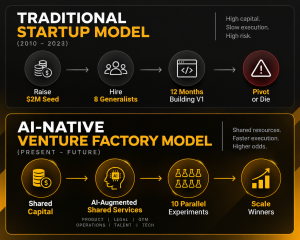
Historically, starting a company required a significant minimum viable headcount:
- A couple of full-stack engineers to build the core backend and frontend.
- A product designer to map user flows.
- A growth marketer to test acquisition channels.
- Operations and legal to keep the lights on.
In 2026, generative models, agentic workflows, and automated dev tools have flattened those skill gaps. A single domain expert paired with autonomous AI agents can execute work that previously required an entire multi-disciplinary team.
Because execution is becoming dramatically cheaper and faster, the bottleneck in venture creation has shifted. Building software is no longer the risk; choosing the right problem and accessing the market is.
2. What Is a Venture Factory?
A Venture Factory isn’t just an incubator or an accelerator with a splash of AI branding. It is an operational engine that treats company creation like an assembly line powered by shared intelligence.
Instead of building one startup at a time from scratch, a venture factory operates with centralized “core infrastructure” that every incoming project hooks into:
| Component | Traditional Startup | Venture Factory |
| Talent Model | Hires full teams for every single idea | Lean domain leads sharing expert centralized teams |
| Validation Speed | 3–6 months to test a value proposition | Days/Weeks using automated AI research & landing tests |
| Operational Context | Starts with a blank slate every time | Retains historical data, playbooks, and learnings across all portfolio builds |
| Capital Efficiency | High burn rate (mostly payroll and overhead) | Low burn rate (focuses capital on high-leverage growth) |
| Risk Profile | Single-point-of-failure (binary outcome) | Portfolio-level risk mitigation across multiple parallel bets |
3. The Four Pillars of an AI-Powered Venture Engine
How does a venture factory actually launch companies faster than traditional founding teams? It relies on four interconnected leverage points:
1. Programmatic Market Validation
Before a single line of production code is written, AI agents scour regulatory databases, scrape customer sentiment across niche forums, run automated ad tests, and map competitor IP landscapes. A venture factory can pressure-test ten business hypotheses in the time it takes a traditional startup to draft a pitch deck.
2. Plug-and-Play Technical Scaffolding
Venture factories don’t rebuild authentication systems, billing pipelines, security protocols, or UI design systems for every new spin-out. They maintain modular, pre-built technical foundations. Developers focus entirely on the proprietary core value proposition, while AI agents handle repetitive boilerplate code, test generation, and refactoring.
3. Shared Distribution Networks & Data Moats
The hardest part of launching a startup today isn’t building the product; it’s getting distribution. Venture factories build persistent, cross-portfolio distribution channels. Furthermore, the operational context learned from Company A (e.g., customer acquisition costs, ad creative performance, user behavior patterns) feeds directly into the algorithms powering Company B.
4. Human-in-the-Loop Leadership
In a venture factory, the human role changes from operator doing manual labor to director guiding execution. Founders are no longer managing large, messy org charts in the early days. Instead, they focus on what AI cannot replace: vision, customer empathy, strategic taste, and high-stakes judgment.
4. The Economic Fallout for Venture Capital
The emergence of venture factories is shaking up the venture capital asset class in three major ways:
- Smaller Fund Sizes, Higher Returns: Because capital requirements for early-stage validation have dropped, venture factories don’t need $50M seed funds to prove out concepts. They can run dozens of targeted experiments on a fraction of that capital.
- The Compression of Time-to-Traction: The timeline to reach $1M in ARR or establish clear product-market fit is compressing from years to months. Companies that fail do so quickly and cheaply, allowing capital to be recycled into winning concepts immediately.
- Shift from Financial Capital to Operational Capital: Pure money is a commodity. Capital providers who only write checks will lose deal flow to venture factories that bring ready-made AI infrastructure, automated distribution, and shared talent networks to the table.
The Road Ahead
The story of the next decade in entrepreneurship won’t be about whether solo founders can build billion-dollar businesses—it will be about the engines that make those breakthroughs repeatable.
We are moving away from the romanticized, chaotic era of two founders in a garage struggling through operational friction, and stepping into an era of streamlined, highly leveraged venture creation.
The future belongs to those who don’t just build products, but build the factories that invent them.