
For generations, venture creation followed an inefficient, capital-heavy playbook. A team would raise millions, hire dozens of specialized roles, spend 12 to 18 months assembling proprietary tech, and hope market demand was waiting on the other end.
In a world where software creation costs are plummeting, that legacy approach is obsolete.
At Nobody Studios, the goal isn’t to build a single massive company over a decade—it is to de-risk and spin out dozens of profitable, resilient ventures at unprecedented velocity. To achieve this, the studio operates as a crowd-infused, AI-native venture creation engine.
By merging hyper-efficient human ingenuity with AI orchestration, venture building shifts from a slow, speculative gamble into a repeatable, scientific discipline.
1. AI Workflows: Amplifying Human Talent Across the Studio
At Nobody Studios, AI is not viewed as a gimmick or a replacement for human judgment—it acts as an exponential force multiplier across every node of the company creation lifecycle.
Traditional startups waste thousands of hours on recurring operational overhead: writing legal boilerplate, setting up marketing funnels, configuring cloud pipelines, and structuring Go-To-Market strategy collateral.
By embedding agentic AI workflows directly into day-to-day operations, internal teams delegate repetitive tasks to custom AI agents. Studio operators step into the role of high-level architects, spending their energy where human intuition matters most: product direction, strategic positioning, and relationship building.
2. Automated Research: Finding Signal in Massive Market Noise
The earliest phase of any venture studio is filtering ideas. Historically, venture research involved analysts manually compiling competitor spreadsheets, scanning industry reports, and guessing consumer pain points over weeks.
Nobody Studios accelerates this phase using automated research agent pipelines:
- Sentiment Mining: AI agents continuously analyze social platforms, product review feeds, and search intent signals to catch emerging consumer frustrations in real time.
- Competitive Analysis: Automated scrapers parse competitive features, pricing shifts, and customer support gaps, generating comprehensive gap-analysis reports within minutes.
- Regulatory & IP Scanning: AI agents cross-reference patent filings and regulatory changes to flag structural industry hurdles before capital is allocated.
This continuous stream of market data gives studio leaders a real-time, data-grounded dashboard of global opportunities, replacing gut-feel speculation with actionable signal.
3. Idea Validation: Killing Bad Ideas Before Writing Code
The costliest mistake in startup building is spending a year building something nobody wants. Nobody Studios turns traditional validation on its head by testing market demand before engineers touch backend code.
Using rapid pretotyping frameworks, the studio tests hundreds of business concepts in parallel:
- Synthetic & Real-User Pretotyping: AI engines spin up conversion-optimized landing pages, visual mockups, and micro-ad campaigns within hours.
- Crowd-Infused Feedback: The studio leverages its global crowd network to gather qualitative insights, early sign-ups, and user feedback at scale.
- Evidence-Based Gating: An idea only earns the right to move to the next stage if real users take meaningful action—whether that means pre-orders, waitlist opt-ins, or deposit commitments.
If a concept fails to meet validation metrics, it is killed or pivoted immediately. Weak ideas are discarded in days at near-zero cost, freeing up resources for high-conviction concepts.
4. Shared Infrastructure: The Plugin Architecture for Venture Building
In a standalone startup, founding teams spend up to 40% of their early capital reinventing the wheel—setting up payroll, selecting CRM platforms, configuring cloud setups, and negotiating SaaS contracts.
Nobody Studios eliminates this redundant overhead by providing every venture with a shared operational plug-and-play architecture:
| Operational Layer | Traditional Startup | Nobody Studios Shared Engine |
| Go-To-Market (GTM) | Hires expensive external agencies | Centralized marketing squad + automated distribution templates |
| Technology Stack | Custom setup built from scratch | Reusable AI microservices, design libraries, and API layers |
| Legal & Finance | High billable attorney hours | Standardized equity structures, compliance templates, and operational support |
| Talent Allocation | Month-long recruiting searches | Fractional expert deployment across portfolio companies based on sprint needs |
By centralizing core functions, new portfolio companies hit the ground running with enterprise-grade operational infrastructure on Day 1.
5. “Frugressive” Building: The Fusion of Frugality and Aggression
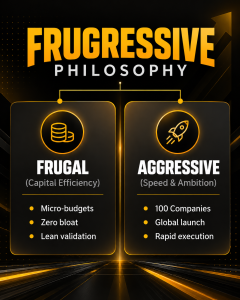
At the heart of the Nobody Studios ethos is a distinct execution mindset: Frugressive Building—the balance of Frugal capital management with Aggressive market deployment.
Traditional venture capital encourages startups to raise massive rounds, spend aggressively on customer acquisition, and pursue a “unicorn or bust” strategy that leaves little room for error.
Frugressiveness operates differently:
- Frugal on Execution Costs: Keep capital commitments minimal until product-market fit is proven. Build using no-code, AI code-gen tools, and shared resources.
- Aggressive on Market Speed & Scale: Move at high velocity. Test dozens of channels simultaneously, pursue global reach early, and target high-conviction market gaps without hesitation.
Frugressive building decouples company growth from massive capital burn, ensuring every dollar spent goes directly toward driving enterprise value.
6. Acquisition-First Design: Architecting for Exit on Day One
Many entrepreneurs spend years building a business only to discover that no strategic acquirer wants to buy it. Their tech stack is messy, their customer data is disorganized, or their market is too niche.
Nobody Studios practices Acquisition-First Design. Before a single line of production code is written or a brand identity is finalized, the studio identifies the potential exit paths:
- Strategic Mapping: Who are the major corporate acquirers in this space? What specific gaps exist in their product roadmaps?
- Modular Architecture: Products are designed to integrate cleanly into larger corporate platforms via clean APIs, modular codebases, and standardized data schemas.
- Unit Economics Priority: Instead of chasing vanity metrics, companies are built on sustainable unit economics, clear margin profiles, and demonstrable retention—the metrics strategic acquirers care about most.
By building with the ultimate end-buyer in mind from day one, the studio optimizes the timeline from ideation to strategic acquisition.
The Future of Startup Creation
Building software is no longer the main constraint in business creation; the true bottleneck is capital efficiency, distribution focus, and execution speed.
By unifying AI-driven workflows, rigorous automated validation, shared studio infrastructure, a Frugressive execution discipline, and acquisition-first strategy, Nobody Studios is crafting a scalable system for company creation.
The future of entrepreneurship belongs to hyper-leveraged teams that move with speed, test with discipline, and leverage intelligent systems to turn ideas into valuable businesses.