
For generations, the recipe for professional status was simple: acquire deep domain expertise.
You spent years memorizing statutes, parsing tax codes, learning syntactic patterns in code, or mastering clinical diagnostic criteria. Expertise was measured by information retrieval, analytical velocity, and the sheer volume of specialized facts stored between your ears.
Today, a generative model can synthesize twenty pages of case law in six seconds, debug complex legacy software, or draft a market entry strategy before you finish your morning coffee.
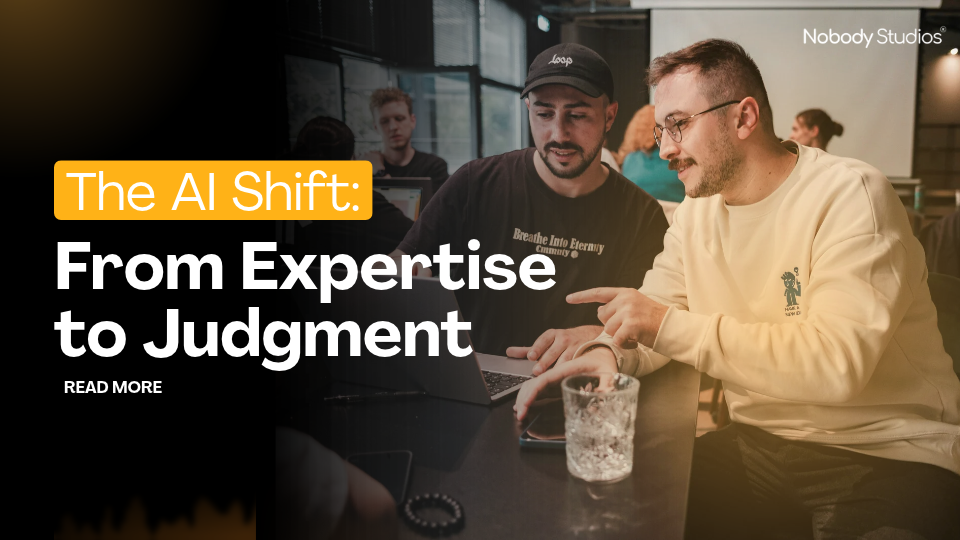
When knowledge becomes nearly free to retrieve, the premium on knowing facts evaporates. We are living through an economic and cognitive transition: the shift from expertise to judgment.
To stay relevant, professionals must understand what expertise actually did, why generative systems change its market value, and what it means to practice judgment as a primary discipline.
1. The Commoditization of Analytical Labor
Traditional expertise is largely about production:
- Drafting memos and syntheses
- Running statistical models and regressions
- Translating technical rules into working templates
Because these tasks take significant human cognitive bandwidth, companies historically treated anyone who could execute them as high-leverage knowledge workers.
Generative AI turns that equation upside down. Large models do not merely retrieve data; they weave disparate concepts together into plausible, highly articulate outputs in seconds.
If your core economic value is producing standard analyses, drafting standard clauses, or summarizing complex articles, you are competing directly with zero-marginal-cost software.
The bottleneck is no longer generating options, text, or code. The bottleneck is deciding which option to back, what question actually matters, and what invisible risks lurk beneath a polished surface.
2. Defining the Difference: Expertise vs. Judgment
While the terms are often used interchangeably, they represent two distinct modes of operating:
| Attribute | Expertise (The “What” & “How”) | Judgment (The “Whether” & “Why”) |
| Primary Function | Pattern recognition and technical execution | Evaluation, discernment, and ethical commitment |
| Operating Mode | Rule-following within established models | Decision-making under uncertainty and missing context |
| Output | Answers, drafts, code, analyses | Choices, trade-offs, boundaries, and accountability |
| Machine Leverage | High (Easily simulated and synthesized by AI) | Low (Requires context, stakes, and human responsibility) |
Expertise tells you how to optimize an ad campaign for the lowest cost-per-click. Judgment asks whether running that campaign damages the brand’s long-term reputation with core customers.
Expertise tells an engineer how to design an automated layoff algorithm. Judgment recognizes that treating severance as an algorithmic output corrodes company culture and institutional trust.
3. The Core Anatomy of Judgment
What does judgment actually look like when an AI model has already delivered a clean, convincing answer? It rests on four distinct capacities:
Framing the Real Problem
AI models are reactive. They answer the prompt they are given, not the problem that actually exists.
A junior analyst might ask: “How do we increase user engagement on our dashboard?” An AI will instantly generate twenty retention tricks.
A professional with seasoned judgment asks a different question: “Is user engagement the right metric, or are customers spending too much time in our software because our workflow is broken?” Judgment sets the boundary conditions before the computation starts.
Managing Context Beyond the Training Window
Every organization operates on implicit knowledge that never makes it into written documents or training corpuses:
- Subtle political alliances between departments
- Historical grievances and customer quirks
- Risk appetites that shift depending on cash flow
- Regulatory environments in flux
Because AI systems operate on explicit inputs, they produce recommendations that sound completely rational on paper but fall apart in real life. Judgment provides the connective tissue between neat models and messy operational realities.
Detecting Plausible Mediocrity and Hallucination
Generative AI outputs rarely look completely broken. Instead, they produce what researchers call plausible fluency—answers that sound confident, authoritative, and articulate, even when fundamentally misguided or subtly flawed.
Exercising judgment means resisting intellectual passivity. It is the discipline of looking past the polished prose to spot false assumptions, cherry-picked comparisons, or missing baseline scenarios.
Moral and Operational Ownership
An algorithm cannot be held accountable. It cannot be fired, sued, or made to look colleagues in the eye when an initiative fails.
Real judgment requires skin in the game. When you endorse an AI-drafted strategic shift or medical recommendation, you are staking your personal and professional credibility on the line. That accountability is precisely what clients and employers are paying for.
4. The Danger: “Agency Decay”
The greatest risk of the generative era isn’t that models will become malicious; it’s that human professionals will quietly surrender their critical faculty.
Recent workplace studies reveal a troubling trend known as agency decay:
“When people use generative assistants that provide fast, fluent recommendations, they stop questioning whether those recommendations are appropriate. The friction that once forced professionals to deliberate disappears.” – Knowledge at Wharton
Decisions don’t fail because the AI made a catastrophic math error; they fail through quiet drift.
- Step one seems reasonable.
- Step two is confirmed by the assistant.
- By step five, a team has committed to an outcome nobody intentionally chose, simply because the machine’s momentum was easier to follow than to resist.
When you delegate thinking to an algorithm, you don’t save time—you surrender agency.
5. Cultivating Judgment: A Framework for Practice
To thrive when standard expertise is an open API, you have to build deliberate friction into your workflow. Before signing off on an AI-assisted deliverable, apply this four-part checklist:
- The Pre-Prompt Hypothesis: What did I believe before I asked the machine? If you enter an AI interaction without an initial baseline hypothesis, you will default to whatever the tool suggests.
- The Inversion Test: If this recommendation turns out to be a disaster in eighteen months, what was the blind spot? AI rarely flags its own assumptions; it’s your job to identify them.
- The Unrepresented Stakeholder: Who is impacted by this choice who was not included in the prompt? Models do not proactively care about ethics, long-term brand equity, or human impact unless explicitly guided.
- The Defense Standard: Can I explain and defend this choice on my own account without citing the AI’s output? If your sole justification is “the tool recommended it,” you haven’t made a decision—you’ve merely rubber-stamped one.
The Path Forward
The rise of generative AI does not spell the end of the knowledge worker, but it does mark the end of unthinking expertise.
Knowing how to write a script, draft a contract, or design a slide deck is no longer a sustainable moat. Those technical skills are baseline table stakes.
The future belongs to the editors, the critics, and the strategists—professionals who can orchestrate machine intelligence without being seduced by its confidence, who know where the model ends and reality begins, and who have the courage to take responsibility for the final call.
Expertise executes the work. Judgment owns the outcome.